Friday, April 24, 2026
Dear Friend,
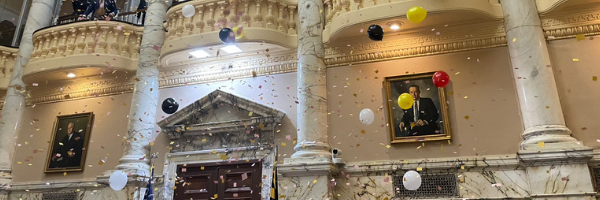
Balloons and confetti marked the conclusion of my 16th, and final , Maryland’s legislative session of the Maryland General Assembly at midnight on April 13. Between the two chambers, over 1800 bills were introduced, and 887 were thoroughly debated and ultimately passed.
Before I launch into a recap of this session, I want to say how grateful I am to have had the opportunity to serve the residents of District 19, and all of Maryland. It has been a good run, with more highs than lows, and we can be proud of what has been accomplished over the four terms. Together with my amazing D19 team, Senator Ben Kramer, Delegates Vaughn Stewart and Charlotte Crutchfield, my Chiefs of Staff, Matthew Weiss, Gary Smith, Brigida Krzysztofik (for the last 11 years!!), my Community Liaison, Ira Ungar, and all the incredibly talented interns who have served in the office, we made strides in making health care more accessible and affordable, increased the number of school-based health clinics, assured dental services for folks on Medicaid and established the first-in-the nation Prescription Drug Affordability Board. I feel very blessed to have been a part of this and many other policy improvements. Thank you for your support over these years.
Please know that I am “on the job” until January 12, 2027, and continuing to work on policy, administering our scholarship program and responding to constituent concerns. Please reach out to the office if we can be of any help.
This End of Session report is intended to briefly highlight some of the more substantive and priority bills passed this year. For a comprehensive view of all the bills, please go to 2026 90 Day Report on the MGA website.
MY BILLS
I am grateful for the support of advocates and stakeholders to pass eight of my bills this session. Here a few for which I am most proud:
HB 1367 Commission on Re-Imagining Health Care in Maryland will establish a comprehensive Commission to envision bold reforms that could transform Maryland’s health care system for generations to come. The Commission will make recommendations regarding establishing a comprehensive health care system in the State and will submit a preliminary report by December 1, 2027, and a final report by December 1, 2029, bringing together stakeholders, experts, and community voices to thoroughly examine how Maryland can build a more equitable, efficient, and accessible health care system that ensures every Marylander.
HB 666/SB 423 Research Facilities and Testing Facilities That Use Animals – Prohibitions and Adoption Requirements (Animal Research Modernization and Best Practices Act of 2026) will modernize Maryland’s approach to animal research by requiring testing facilities to transition away from traditional animal testing methods when scientifically equivalent alternatives are available. The bill strengthens adoption requirements for animals no longer needed in research, ensuring they have the opportunity to find loving homes through approved animal rescue organizations, while also supporting the development of human-relevant alternatives that can advance scientific progress without harming animals.
HB 1093/SB 808 Health Insurance – Provider Panels – Requirements will improve the process by which licensed providers can be credentialed by insurance companies, ultimately making it easier for qualified providers to serve patients and for families to access the care they need.
SB 18/HB 769 State Board of Social Work Examiners – Provisional License to Practice Social Work – Established will address Maryland’s critical shortage of licensed social workers by creating a provisional licensure pathway for qualified graduates. Individuals who have completed the education and experience requirements will be allowed to practice while working toward passing their licensing examination. This will get much-needed professionals into the field more quickly while maintaining quality standards through supervision and eventual examination requirements.
The following legislation did not pass with the understanding that workgroups would be formed during the interim to resolve the issues addressed in the bills:
HB 1469 Health Insurance – Workgroup to Study the Definition of Specialty Drug will be addressed by the Maryland Insurance Administration’s Pharmacy Benefit Manager workgroup to study with the goal of recommending a modernized definition of specialty drugs that balances patient access with cost considerations.
HB 944/SB 494 Maryland Health Care Commission – Certificates of Need and Material Change Transactions would have expanded the Maryland Health Care Commission’s (MHCC) oversight authority over mergers, acquisitions, and ownership changes for health care facilities and provider practices. The MHCC leadership has agreed to work with the Maryland Hospital Association (MHA), the Maryland Medical Society (MedChi) and the Maryland Insurance Administration to establish a transparent public interest review process for these material change transactions and return recommendations in the 2027 session.
D19 Legislative Bond Initiatives
On behalf of Johnson’s Local Park, your District 19 representatives secured a total of $1,000,000 for renovations including playground renovation, ballfield improvements (including lighting), sports court conversions, picnic shelter replacements, historic interpretation, ADA accessibility improvements, parking lot improvements, support infrastructure, and site furnishings.
Sheppard Pratt is the nation’s largest private, nonprofit provider of mental health, substance use, developmental disability, special education, and social services in the country, with a satellite facility in the heart of D19. We secured a total of $650,000 to upgrade safety and security to protect students, staff, and visitors in the event of an emergency, including potential active-shooter situations. Renovations and improvements essential to ensuring a safe, secure, and therapeutically appropriate environment for students with complex behavioral and emotional needs.
HEALTH CARE
As vice chair of the Health Committee I am very proud of the new chair and the entire committee for their diligence and persistence this session. We heard many bills and spent many hours on some of the most critical policies and programs to improve access to health care, including addressing coverage for additional services, expanding the practice of some health care professionals and considering the needs of older and vulnerable Marylanders. To see a more complete list Health Committee’s End of Session Highlights. Here are just a few bills that passed.
HB 637 / SB 385 – Public Health – Recommendations for Immunizations, Screenings, and Preventive Services – Pharmacist Administration and Required Health Insurance Coverage (The Vax Act): This bill is a response to the shifting and non-evidenced based recommendations now being promulgated by the Center for Disease Control. It assures the Secretary of Health to issue, publish, and distribute recommendations for immunizations, screenings, and preventive services based on the science and the experiential knowledge of professional medical organizations.
HB 1109 / (SB 790) – Public Health Reform Act: This bill takes a comprehensive approach to access to health care by setting up the accountability requirement for implementation of the recommendations of the Commission on Public Health.
HB 624 / SB 411 – Hospitals – Clinical Staffing Committees and Plans – Establishment (Safe Staffing Act of 2026): In order to provide the best services, hospital management should include front-line staff in in decision-making. This bill requires each hospital to comply with the staffing standards of the accreditation body that accredits the hospital and the federal Centers for Medicare and Medicaid Services (CMS) Conditions of Participation (CoPs) by including regular input from front line nursing staff.
HB 1002 / SB 493 – Nursing Facilities – Involuntary Discharge or Transfer: Recently we have seen irresponsible placements of vulnerable adults. This bill addresses that concern by requiring that (1) the notice provided to a resident regarding any proposed discharge or transfer; (2) a new notice of any proposed discharge or transfer, including applicable timing requirements for discharge or transfer under a new notice; and (3) a post discharge plan of care.
HB 1118 / SB 891 – Health, Health Insurance, and Health Occupations – Perinatal Behavioral Health Conditions: Maryland’s rate of infant and maternal mortality is unacceptable. One issue is the mental health challenges sometimes faced by new mothers. These bills require certain health care providers to screen for a “perinatal behavioral health condition” which will be covered by insurance, including Medicaid. They must also develop training programs to recognize issues sooner.
HB 811 / SB 530 – Aging-in-Place Programs – Grants – Multigenerational Third Places (Village Multigenerational Third Places Act): These bills provide grants to nonprofit organizations that support social connections for older adults who are choosing to stay in their homes.
Health Insurance
As the Health Insurance Subcommittee chairman, I was proud to shepherd some much needed bills through my subcommittee. Here are a few:
HB 280 / SB 205 – Health Insurance – Mental Health and Substance Use Disorders – Codification of Federal Requirements: The Maryland Insurance Administration is continuing to monitor access and insurance coverage for mental health services. These bills codify how the metrics for accountability are determined and increase accountability for insurance carriers.
HB 684 / SB 521 – Health Insurance – Material Changes to Provider Networks – Notification and Special Enrollment Period: Insurance carriers contract with hospitals to provide services at in-network rates. Last year a major hospital system and insurance carrier were not able to come to agreement, leaving those enrollees with fewer in-network options. These bills require notification to enrollees in these cares and adherence to the existing contract for 90 days to provide for continuity of care and a chance to find new providers.
HB 1365 / SB 892 – Health Occupations, Public Health, and Insurance – Menopause – Provider Training Coverage Requirements, Policy Initiatives, and Access to Care: The treatment of menopause and its associate symptoms has been identified by both the public and medical professionals as lacking in current practice. These bills require coverage of the treatments and increased training for professionals specifically in these areas.
OTHER LEGISLATIVE PRIORITIES
Beyond my wheelhouse of health, the Maryland General Assembly (MGA) passed legislation addressing the rising costs for utility ratepayers, protecting immigrants, and expanding access to housing. We also made improvements in our juvenile justice and foster care systems. Here are some of the highlights.
THE BUDGET
Each year, the MGA is constitutionally required to pass a balanced budget. This year the FY 2027 debate centered on not increasing taxes and/or fees, but re-aligning current resources to meet needs in education, transportation, economic development, and basic human needs, without raising taxes or fees.
Reducing the cost of utilities was a major focus this session. In the budget there were allocations of over $300 million dollars specially to offset some of the increases, including $100M towards the cost of the EmPOWER program and $73M to subsidize power efficient heat pumps in low and moderate-income households.
The FY 27 Budget continues to fully fund the education Blueprint, unfreezes the Child Care Scholarship waitlist, supports our higher education system, invests in food programs for low-income students and promotes our economic competitiveness.
There are significant investments in social services, including $1.8 billion for food subsidies needed because of the harsh federal cutbacks, going to families, and seniors, over $424 M in rental assistance, including in some designated rural communities and $25M to provide down payment assistance in the Maryland Mortgage Program, $400 M in energy assistance programs and $4M in subsidies for senior living programs.
Maryland is committed to supporting our individuals with intellectual and developmental disabilities (ID/DD), and providing in-home services through federal waiver programs. However, the cost of these programs has been uncontrolled in recent years and we are at risk of losing our federal matching dollars. Over the past five years, the program has doubled in size. As a result it was necessary to make some difficult decisions and some cost containment nuanced changes that will reduce the overall state budget by $127M. Our commitment is steadfast and we believe that even with these cuts, services can be provided. The Department of Developmental Disabilities will be working with families about how adjustments can be made with the least amount of impact.
With respect to public safety, $47M were restored to provide funding for local law enforcement to address community needs, $250,000 to reopen a youth treatment center and ensure that sexual assault victims get the information and support they need by setting notification protocols.
For complete information on the budget go to https://dbm.maryland.gov/budget/pages/operbudhome.aspx.
OTHER PRIORITY BILLS
HB1532 Utility RELIEF (Reducing Energy Load Inflation for Everyday Families) Act: We heard from constituents that the fact that energy costs had doubled or tripled in recent years was devastating to their budgets. This bill is a comprehensive approach, including both short and long-term goals. In the short term, rate-payers should see a cost decrease of at least $150 a year. In addition, costs are constrained by requiring data centers to pay for their impact. Payers will not be responsible for covering the costs of excessive employee compensation and extending power lines beyond where they live.
HB 444/SB245 Public Safety – Immigration Enforcement Agreements – Prohibition and SB791/HB1575 Correctional Services and Criminal Procedure – Immigration Enforcement – Prohibitions (Community Trust Act): These bills codify in practice our state values for constitutional civil rights and justice for all residents of the state. The first bans cooperation agreements, known as 287g programs, between ICE and local police, leaving the control in the hands of local law enforcement, not an extreme anti-immigrant agenda. The second assures that an individual who is detained by local or state law enforcement cannot be turned over to ICE without a valid court order.
HB980/SB996 Family Law and Human Services – Guardianship Assistance Program and State Foster Youth Ombudsman – Establishment (Kanaiyah’s Law): Our broken system of placement of foster youth was in the spotlight last year when a 16-year old girl died when placed alone in a hotel while in state custody. This bill creates greater oversight with a Guardian Assistance Program and an ombudsman.
HB409/SB323 Juvenile Court – Jurisdiction (Youth Charging Reform Act): In recent years legislation has passed designed to provide multiple rehabilitation options for youth who commit crimes. However, they did not address the fact that Maryland has a very high rate of charging children under the age of 16 as adults. This bill limits the number of serious charges for which a child is automatically sent to adult court, while still holding them accountable. It provides for age-appropriate services that prioritize treatment and rehabilitation.
HB548/SB325 Land Use – Permitting – Development Rights (Maryland Housing Certainty Act): Increasing available housing was another priority this session. This bill addresses that issue by responsibly reducing the regulations and red-tape often encountered by housing developers and prohibits any local impact fees on any project until the construction is completed.
Here are the Speaker’s 2026 Session Passed Priority Bills, as well as the Speaker’s Press Release Overview for the House agenda on Affordability, Accountability, and Opportunity.
CLOSE TO HOME
This year, the Montgomery County delegation advocated for county funding and considered 16 local bills.
State aid to the county will increase by 1.2%, including $172 million for capital projects. We will receive $1.2 billion for public education, a $29 million increase. There is an additional $54 million for school construction and renovations in MCPS and $9.7 million for Montgomery College.
In addition, a variety of other capital projects were funded, including transportation, public safety, cultural arts, and historic preservation.
Nine of the local bills completed the legislative process and are awaiting the governor’s signature. They cover diverse policy areas, from simplifying the Community Choice Program allowing for more communities to aggregate their purchase of gas and electricity to defining the governance of special taxing districts, such as the Village of Drummond. The complete list of passed local bills is below. Specific information about them can be found at the MGA website.
- HB 328, Bicounty Commissions – Public Ethics – Financial Disclosure Statements PG/MC 105-26
- HB 597 Montgomery County – Community Choice Aggregation Pilot Program – Alterations MC 17-26
- HB 601, Montgomery County – Stop Sign Monitoring Systems Pilot Program – Gaithersburg and Rockville MC 5-26
- HB 936, Montgomery County Public Schools – Jane E. Lawton Local Food Procurement MC 7-26
- HB 1252, Department of Housing and Community Development – Montgomery County Study MC 19-26
- HB 1084, Montgomery County – County Board of Education – School Operation Requirements MC 14-26
- HB 1230, Washington Suburban Sanitary Commission – Procurement – Alterations PG/MC 102-26
- HB 1267, Patuxent Research Refuge and Beltsville Agricultural Research Center – Zoning Classification (Protecting Patuxent Research Refuge Act)
- HB 1623 /CH0149, Special Taxing Districts – Village of Drummond – Authority and Organization MC 20-26
CONSTITUENT’S PRIORITIES
During the session, we received calls, emails, and letters regarding over 150 bills from constituents. Fifty of those bills passed and are on the Governor’s desk. I supported and voted for each of them. A list of those bills is provided under my signature below. To learn more about any of them, go to https://mgaleg.maryland.gov/mgawebsite/ and type the bill number into the search bar.
STAY IN TOUCH
As always, please feel free to reach out to me in the interim with your thoughts, ideas, feedback and questions. While I am officially retiring from public office, we are at your service through December 2026. You can reach me at BonnieCullison@house.state.md.us or at 410-841-3883. Have a wonderful spring!
Bonnie Cullison, Delegate, District 19 — Montgomery County

Bills we heard from you about and they are awaiting the Governor’s action:
- HB 14, County Boards of Education – Bullying, Harassment, or Intimidation – Information Collection and Reporting Requirements
- HB 106/SB 6, State Personnel – Collective Bargaining – Nontenure Track Faculty
- HB 211 /SB 30, Baltimore County – Property Tax Credit – Fraternal Order of Police Lodge 34
- HB 273/SB 14, Health Insurance – Small Business Health Options Program (SHOP) Enrollment – Effective Dates
- HB 319/SB 292, County Boards of Education – Student Transportation – Sunset Repeal and Study
- HB 372/SB 169, Hospitals – Emergency Pregnancy-Related Medical Conditions – Procedures
- HB 374/SB 370, State Acupuncture Board – Revisions
- HB 392/SB 284, Budget Reconciliation and Financing Act of 2026
- HB 409/SB 323, Juvenile Court – Jurisdiction, Detention, and Confinement (Youth Charging Reform Act)
- HB 444/SB 245, Public Safety – Immigration Enforcement Agreements – Prohibition
- HB 446/SB 5555, Health – Dementia Services and Brain Health Program and Provider Resource Toolkit
- HB 457, Institutions of Higher Education – Provision of Menstrual Hygiene Products – Requirement
- HB 476/SB 474, Civil Actions – Noneconomic Damages – Personal Injury and Wrongful Death — This one didn’t pass as a bill but will be turned into a study.
- HB 548/SB 325, Land Use – Permitting – Development Rights (Maryland Housing Certainty Act)
- HB 564, Pet Cremation and Burial Services – Requirements (Pet Cremation and Burial Services Consumer Protection Act)
- HB 577, Criminal Law – Firearm Crimes – Machine Gun Convertible Pistols
- HB 578/SB 431, Fish and Wildlife – Endangered and Threatened Species and Migratory Birds – Regulations, Lists, Petitions, Essential Habitats, and Takings
- HB 634/SB 745, Police Training – Autism and Dementia (LEAD Act of 2026)
- HB 637/SB 385, Public Health – Recommendations for Immunizations, Screenings, and Preventive Services – Pharmacist Administration and Required Health Insurance Coverage (The Vax Act)
- HB 658/SB 412, Maryland Department of Health – Forensic Review Boards and Community Forensic Aftercare Program
- HB 701/SB 523, Department of Natural Resources – Water Resources – Identification of Vernal Pools (Jack Cover Vernal Pools Act of 2026)
- HB 711/SB 504, Data Privacy – Consumer Data, Public Records, and Message Switching System (Data Privacy Act)
- HB 728/SB 641, State Procurement – Exceptions – Historic Preservation Services (The Honorable Barrie S. Ciliberti Historic Preservation Act of 2026)
- HB 738/SB 651 ,Real Property – Transfer-on-Death Deed – Establishment
- HB 769 /SB 18, State Board of Social Work Examiners – Provisional License to Practice Social Work – Established
- HB 797/SB 439, Amendments Convention Called Under Article V of the U.S. Constitution – Delegation to the Convention
- HB 848/SB 621, Public Safety – State Fire Prevention Code – Trash and Recyclable Materials
- HB 892/SB 233, Business Regulation – Cemeteries and Abandoned Cemeteries – Sale, Transfer, or Government Acquisition and Disposition
- HB 894/SB 389, Land Use – Transit-Oriented Development – Alterations (Maryland Transit and Housing Opportunity Act)
- HB 895/SB 387, Food Retailers and Third-Party Delivery Service Providers – Dynamic Pricing and Personal Data (Protection From Predatory Pricing Act)
- HB 1014/SB 707, Mental Health Law – Definition of Danger to the Life or Safety of the Individual or of Others and Reports on Emergency Evaluation Petitions (Right to Treatment)
- HB 1017/SB 984, Correctional Services – Private Detention Facilities – Zoning Requirement
- HB 1091/SB 813, Health Insurance and Dental Plan Organizations – Dentists – Assignment of Benefits and Reimbursement of Nonpreferred Providers
- HB 1137/SB 829, Residential-in-Commercial-Zone Laws – Study (Bring Back Main Street Act)
- HB 1151/SB 611, Maryland Department of Health – Study on Maryland Medical Assistance Program Reimbursement of Hospice Room and Board Services
- HB 1280/SB 809, Supporting Our Caregiver Infrastructure Program – Feasibility Study
- HB1377, Prescription Drug Repository Program – Redirecting Safe Prescription Drugs Pilot Program
- HB 141/SB 84, State Personnel – Collective Bargaining – Graduate Assistants
- HB 1430/SB 960, Maryland Public Charter School Program – School Facilities – Funding
- HB 1445/SB 742, Maryland Medical Assistance Program and Developmental Disabilities Administration – Home- and Community-Based Services Eligibility Determinations (Maryland Protecting People With Disabilities Act)
- HB 1523/SB 820, Alcohol, Tobacco, and Cannabis Commission – Unauthorized Consumable Products – Enforcement and Seizure
- HB 1532/SB 341, Utility RELIEF (Reducing Energy Load Inflation for Everyday Families) Act
- HB 1533/SB 656, Public Health – Cosmetic Products – Enforcement and Penalties for Prohibited Ingredients (Crown and Care Act – Protecting Communities from Harmful Hair Chemicals)
- HB 1557, Procurement – Real Estate Advisory Committee and Property Acquisition and Lease Requirements
- HB 1575/SB 791, Correctional Services and Criminal Procedure – Immigration Enforcement – Prohibitions (Community Trust Act)
- HB 1578, State Procurement – Procurement Preferences – Reauthorization and Revisions
- HB 1599/SB 558, Chesapeake Bay – Enhancement Program and Maryland Seafood Industry Financial Assistance Fund – Established